Obtaining A Loan On A Newly Built Kansas City Condo Is Possible

Hands On The Heartland
Checking The Pulse Of The Kansas City Real Estate Market 

The difficulties in the coastal condo markets has affected the condo market here in the Kansas City area as well. This is especially true on newly constructed condos where Fannie Mae lending guidelines have become much more stringent. Fannie Mae has indicated the organizations lack of interest in backing condo loans unless the particular new home community is well on its way to completion. This poses an obvious chicken versus the egg dilemma of  selling condos when a community is in the infant stages so you can get the community to the point that it is Fannie Mae approved for home buyers.


This is a serious problem when it comes to condo sales because many lenders rely on obtaining Fannie Mae approval before committing to provide a borrower the loan. The result of Fannie Mae rejection is leaving many condo developers scratching their heads and also putting many homebuyers in a difficult position. These buyers often have  to work much harder to get their loan in place and it threatens to put the borrower’s earnest money at risk. On new home construction in Kansas City, a buyer’s earnest money is typically non-refundable. I recommend bucking tradition and having a buyer demand the contract be written to make their earnest money refundable for 30 days while they work to secure their loan. Given the alternative, many developers and home builders will be willing to concede on this point.


In 2008 I had three newly constructed condo listed and, once the properties went under contract, it was quite a process to get them closed. As discussed previously, these new condos were categorized as “non-warrantable” by Fannie Mae. This means that the lender making the loan would likely encounter difficulty if trying to sell the mortgage loans off (now or later) to another investor. Keep in mind that a majority of lenders ultimately do intend to sell their loans off.


Knowing that very, very few borrowers can pay cash for a home, the other option that comes to mind is checking to see whether the developer of the community would be willing to finance the buyers. But finding developers capable and/or willing to get into the lending business is difficult at best. I checked with several lenders I know and without Fannie Mae approval it wasn’t going to work out. So I decided I’d have to take the unusual measure of interviewing many lenders. It was my plan to ask (1) if they are capable of providing mortgage loans on non-warrantable condos (assuming a qualified buyer with good credit and 5% down payment), (2) if they offer a 30-year fixed rate loan on condo loans (rather than risky 5-year ARMS) and (3) if they are able to provide the loans at reasonable rates and loan costs.


So I was off and running and after looking over a large lists of lenders I narrowed things down to 27 that I intended to contact. In my initial email to these lenders, I only asked whether or not they were capable of providing loans on non-warrantable condos. Five of the lenders never called me back. 17 of lenders told me to take a hike – and I politely told them “I think I will, the weather here’s sweet” (ha, ha). So this left five lenders who said that (assuming a solid borrower) they were capable of providing loans on non-warrantable condos. Things were looking brighter.


So it was on to the second question of whether these lenders were able to offer a 30-year fixed rate loan. Unfortunately two of the five lenders only offered 5-year ARMS and just in case you’re not up on ARMS these days, ARM rates are horrid. Not to mention ARMS are at the crux of much of the real estate mess we are seeing today and in today’s market should be avoided in most cases. Those two lenders we’re thus removed and I was down to three possibilities. So it was on to the next questions of rates and fees. One of the remaining three quoted interest rates and fees that were so high I asked him the last time he made one of those loans. He said “all the time” but forgive me if I don’t believe him. 


So I was down to two lenders and fortunately things improved from there. These lenders were offering 30-year fixed rate loans and also at solid interest rates and reasonable loan fees. As an added bonus, both were responsive and one of the lenders responded just slightly quicker than the other. Things moved swiftly thereafter and one of the sales closed in two weeks. It was great to see the deals close and although I didn’t represent the buyers in these transactions, it was very rewarding to see them smiling at the closing table.  It certainly would have been easy to throw in the towel early in the process but this was a case where persistence paid off.


Posted by Jason A. Brown

Comments Can Be Left Below…
Don’t see the LEAVE A COMMENT section below? 
Click on the headline at the top of this blog post.

Looking For Something To Do In Kansas City? Try Crown Center

Hands On The Heartland
Checking The Pulse Of The Kansas City Real Estate Market 

The new year is here yet we’re  still a couple of months away from the blooming flowers and the  crack of the Kansas City Royal’s baseball bats. If you’re looking for something to get out of the home and do this winter, consider heading to the south side of downtown to visit Crown Center. The shopping and restaurants at Crown Center are reason enough for many to visit but there’s also the appeal of an outdoor ice skating rink, youth activities, fountains and various shows. 

For years Crown Center has been a premier shopping district with three levels of shops. There are currently 50+ shops and restaurants and adding to the Crown Center allure are multiple movie theaters, including The American Heartland Theater’s Broadway style productions, The Coterie Theater’s youth productions and the cutting edge Off Center Theater. Coming later this month is Crown Center’s “70 Years of OZ” exhibit, where kids can meet the Scarecrow, Tin Man and Cowardly Lion. If you’re interested in staying the night in the Crown Center area, you can stay at the 45-story Hyatt Regency Crown Center hotel or the wonderful Westin Crown Center hotel.

In December my family became part of the more than five million visitors that are expected to have visited Crown Center in 2008. We enjoyed eating at Fritz’s Railroad Restaurant and I received slightly less enjoyment from my wife’s shopping. Fortunately I had the boys to entertain me but  I wish I’d dressed the boys warmer so we could have spent some time at the ice skating rink. My wife probably wishes the same as it would have allowed her more time to shop.

Posted by Jason A. Brown

Comments Can Be Left Below…
Don’t see the LEAVE A COMMENT section below? 
Click on the headline at the top of this blog post.

Pheasant Run Subdivision Market Stats * Pheasant Run Homes For Sale In Overland Park KS

Hands On The Heartland
Checking The Pulse Of The Kansas City Real Estate Market

Pheasant Run Subdivision Market Statistics
Pheasant Run Is An Overland Park Kansas Home Community

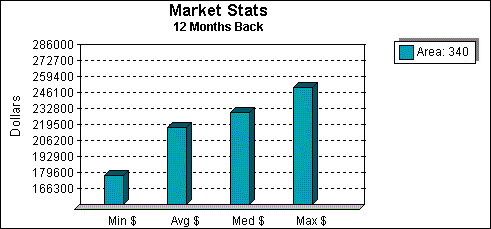
Going back to January 2008 and looking at right around a year’s worth of market stats in Pheasant Run, 14 homes were listed for sale and 11 homes were sold. Home prices in Pheasant Run ranged from $177,000 to $250,000 with an average sales price of $216,209.

Stats pulled from Heartland MLS & deemed reliable but not guaranteed. Stats cover approximately 1 year of market activity & may vary. Note the date of this post as market stats quickly become outdated.

Comparing the current rate of sales over the past year to the 2 active listings in Pheasant Run, there’s about 2 months of inventory on the market, which is great in our current real estate market. 

If you’re considering a move and would like to discuss these market stats and your specific situation, I look forward to speaking with you. When representing our client’s best interests, we dig in deep to analyze past market stats, current market stats, prevalent market conditions and, most importantly, our client’s needs…

View Pheasant Run Homes For Sale (updated daily)

Buying A Home In Pheasant Run

Selling Your Home In Pheasant Run

Posted by Jason A. Brown

Comments Can Be Left Below…
Don’t see the LEAVE A COMMENT section below? 
Click on the headline at the top of this blog post.

Overland Park Kansas Real Estate Update * 15-days Of Overland Park KS Market Stats

Hands On The Heartland
The Pulse Of The Kansas City Real Estate Market

City of Overland Park Kansas Real Estate Update <> 15-day Glance:

Overland Park KS Real Estate Market Stats

Type

#

Average $

DOM

Newest Listings

57

$346,967

View These Listings

Total Active Listings

948

Newest Pending

22

$299,803*

105

View These Pendings

Recently Sold (Closed)

31

$251,306

72

View These Solds

* The average price of the Newest Pending is the list price of the home when it went under contract – actual contract and/or sales price unknown until post-closing reporting. Notes: All information is deemed reliable but not guaranteed. If there is a low sampling of homes in any particular category, an average can be easily skewed high or low by an unusually high or low sale during the 15-day period. Note the date of the post as any market stats quickly become outdated. Depending on when the stats were pulled the stats may not be an exact 15 days.
 

In the city of Overland Park Kansas there continues to be more homes coming on the market (57) than homes going under contract (22 new pending) or than homes being sold (31 closed). This creates a further surplus of supply in Overland Park. Using the past 15 days as a basis for figuring the absorption rate in Overland Park, there is just over 15 months of inventory on the market.  Keep in mind that a 15-day period is a small sampling of market activity designed to look at the what’s going on now in the current real estate market. A 15-day period doesn’t necessarily show a real estate markets long-term trend. Also note that January is a typically slow time of year for sales. We’ll check back later this winter to see how things are looking.

WOULD YOU LIKE TO RECEIVE AUTOMATIC EMAIL UPDATES ON YOUR SUBDIVISION?
Click Here Submit Contact Info
1) In the Subject line put “Receive subdivision updates”.
2) In the Comments section indicate the name of your subdivision.
3) Valid contact information is required.
Note: Once completed, you’ll receive an email catching you up with the current market activity in your area. You’ll then receive an email update when homes in your area are listing, go pending, change price or are sold. 

Posted by Jason A. Brown

Comments Can Be Left Below…
Don’t see the LEAVE A COMMENT section below? 
Click on the headline at the top of this blog post.

The Buying Side Of The Kansas City Short Sale Process (Part 3 In Our Short Sale Series)

Hands On The Heartland
The Pulse Of The Kansas City Real Estate Market

This is Part 3 in our 3 part series on Kansas City Short Sales. Part 3 is “The Buying Side Of The Short Sale Process” and we’ll provide insight into what home buyers and a buyer’s agent are likely to encounter during the Short Sale process. As you read in Parts 1 and 2 of the series, Short Sales have become more commonplace in today’s evolving real estate market. Once a buyer has decided to move forward with attempting the purchase of a Short Sale property, there are several steps in the process that they’ll need to consider. Also, for the remainder of this post, the term “lender” refers to the “seller’s” current lender. Any reference to the “buyer’s” lender will be clearly stated…

(Part 1 of 3) The Kansas City Short Sale Process: An Introduction To The Short Sale Process
(Part 2 or 3) The Kansas City Short Sale Process: The Selling Side Of The Short Sale Process
(Part 3 of 3)
The Kansas City Short Sale Process: The Buying Side Of The Short Sale Process

The buying side of the Short Sale process is typically much simpler than the selling side of the transaction. The most important trait a Short Sale buyer and a buyer’s agent should possess is patience. A buyer without patience should not be considering a property that is subject to a lender’s Short Sale approval. Buyers should anticipate that many Short Sales will see the close dates get extended at some point as all parties work towards an acceptable Short Sale agreement.

If a buyer is not willing and able to wait the weeks or months it may take to see if a Short Sale makes it through to the closing table, the buyer definitely should avoid listings that are advertised as Short Sales. Buyers should review the “remarks” section in the Multiple Listing Service (MLS) to see if the home is subject to a lender’s Short Sale approval. Keep in mind this information could be listed in the agent-only section of MLS (where a Realtor must be logged in to MLS to view it), so it’s important that a buyer ask their agent to look closely if they suspect a property may be subject to a Short Sale. It’s also possible the listing agent is not stating a Short Sale listing as such, so if the price of a property appears well below other area comparable homes in an area it could be an indication the property may be subject to a Short Sale – contact the listing agent to find out.

Lender’s response times during the Short Sale process can be very slow at times but the situation is improving as more lender’s commit to staffing more employees in their Loss Mitigation Departments. By doing so, lenders provide a better chance of a Short Sale being completed and potentially minimizing the lender’s loss on a given property.

A good initial question for a buyer’s agent to ask a listing agent on a Short Sale is whether the listing agent has made contact with the seller’s lender to discuss a potential Short Sale on the property. If a listing agent has not yet received a return call from the seller’s lender, it should raise a yellow flag. If the listing agent has not yet attempted to make contact with the seller’s lender, it should raise a red flag and a buyer should seriously debate whether the property is worth pursuing. One of the most important aspects in getting a Short Sale completed is the Short Sale Package that will have to be sent to the lender along with the contract later, so the listing should have contacted the lender by the time a buyer’s agent starts asking questions about the property.

Once a buyer’s agent has assisted the buyer in locating, viewing and moving forward with an offer, the buyer’s agent may find themselves limited in how much assistance they can provide with the Short Sale aspect of the sale. A buyer’s agent still has all the other typical buyer issues to deal with (such as the buyer’s financing and inspections) but a buyer’s agent should let the buyer know that only the listing agent has permission to speak with the seller’s lender during the process. A buyer’s agent should also explain the “seller’s” side of the process in detail to the buyer so they understand that a lot of patience will be necessary.

When making an offer on a Short Sale listing, a buyer should make a solid initial offer that they believe has a good chance of being accepted by the seller’s lender. Short Sales clearly are not about beating up the seller, rather they’re about gaining “acceptance” from the lender. Keep in mind that a seller is likely to accept any offer a buyer makes (assuming the seller believes it has a good chance of being accepted by the lender). Also know that many lenders are unwilling to do a negotiating dance with a buyer, so it’s important a buyer make a solid first offer if they have serious hopes of purchasing the property.

Once the seller has agreed to a buyer’s offer, the offer is sent on to the lender’s Loss Mitigation Department in hopes of gaining lender approval on the offer. Buyers should be prepared for a slow response from the lender and then once a response is received it may contradict actual market conditions affecting the property. The lender’s Loss Mitigation Department is probably located in another state or country and may not understand relevant “local” real estate market conditions. The agents involved in the transaction should work to overcome any lender objections by providing any “proof” that a buyer’s offer is legitimate and is in the lender’s best interest.

If the lender is considering a buyer’s Short Sale offer, the next step is the lender ordering a Broker Price Opinion (BPO) (or possibly a Certified Appraisal) to be completed on the property. As a general rule, a BPO is a price opinion of the property and something more detailed than a Realtor’s typical Market Analysis (but less in-depth than a Certified Appraisal). A BPO will be done by a real estate agent who is independent to the transaction and who is not the listing agent or the buyer’s agent on the transaction, if applicable. The BPO process involves forms that must be precisely filled out before they are submitted to the lender.

BPO agents get paid very little for their BPO services, so it shouldn’t be assumed that the BPO agent will make it a high priority. It’s acceptable for the agents involved to attempt to contact the BPO agent and let them know the importance of getting the BPO done quickly. With the goal of making sure the BPO agent uses proper comparable properties to arrive at a BPO value, a buyer’s agent (or listing agent) could send the BPO agent a list of comparables they believe are appropriate. The BPO agent must be willing to accept this assistance.

Generally, many lenders aren’t accepting Short Sale offers that are more than 10% below the BPO value. Thus if the BPO agent overvalues the home it could be devastating to the success of the Short Sale in the works. If this were to occur then the listing agent should provide the lender comps that indicate otherwise and/or request that the lender order a new BPO from a different real estate agent (which the lender may or may not be willing to do).

After the lender has made the decision to accept a Short Sale offer, they’ll send the listing agent an Acceptance Letter detailing the agreement between the seller and lender. The seller must be agreeable and sign the Acceptance Letter for the Short Sale to move forward. Once that part of the process is completed, the chances of a successful Short Sale are significantly improved.

Buyers should consider the risk of spending upwards of $1,000 on an appraisal and the inspection process, only to find out later that the lender will not accept a Short Sale or to see the Short Sale fall apart later for some reason. Unfortunately this is the buyer’s sole risk and if the deal falls apart there won’t be anyone standing around to refund the buyer the money they’ve spent to that point. With the idea of protecting the buyer, the buyer could write into the contract that: (1) the buyer’s Financing Contingency period is through the close date and/or (2) the buyer’s 10-day inspection period doesn’t begin until AFTER receipt of the (lender and seller) signed-off Acceptance Letter. This could prevent the buyer from an outlay of cash until the Short Sale process is further along.

Regarding the condition of a Short Sale property, expectations should be that neither the Short Sale seller nor the lender will be willing to make any repairs to the property. Thus Short Sale properties are almost always sold in “As-Is Condition”. Although buyers are usually welcome to conduct their own inspections and make a decision at that time on whether to “take it, or leave it”, it would be futile for a buyer to ask anyone involved with the Short Sale to make (or pay) for any repairs.

It’s recommended that a buyer put an escape provision (such as a 15-day or 60-day expiration date) in the contract that would give the buyer the option of canceling the contract should the negotiations between the seller and lender become prolonged. If this is the first Short Sale offer the seller has received, then a 60-day expiration could make sense. If the seller has received a previous offer that didn’t work out, then the expiration could be less. A reasonable amount of time should be allowed in anticipation of a slow response from the seller’s lender.

Because Short Sales have become more commonplace, many regional association of Realtors now offer a specific “Short Sale Addendum” that can be used in a buyer’s offer to purchase a Short Sale property. Here’s some verbiage from the Kansas City Regional Association of Realtors “Short Sale Addendum”…

* Buyer and Seller acknowledge that the Seller’s obligation to close on this transaction is conditioned upon Seller obtaining an agreement from Seller’s lender or other creditors to a reduction in the payoff amount required to obtain a release(s) of the mortgage/deed of trust or other lien(s).

* Buyer and Seller understand that all lien holders shown on the title commitment must be released in order for the Seller to convey clear title and provide a title insurance policy to the Buyer.

* Buyer and Seller understand and agree that it is the responsibility of the Seller to negotiate any reduction in payoff amounts due and that Seller’s agent will not and cannot be responsible for such negotiations.

* Buyer and Seller understand that negotiations with Seller’s lender(s) or other creditors may disrupt the normal closing schedule for this transaction and that delays can be expected.

* Buyer and Seller understand that Seller’s lender(s) or other creditors may require changes in the terms of this contract as a condition to their approval of a reduced payment (Short Sale).

* Buyer understands that any sums they spend on inspections, loan applications or other matters in anticipation of this transaction will be at Buyer’s expense whether or not Seller is able to obtain approval of their lender(s) or other creditor(s).

* If Seller is unable to obtain the written agreement(s) of lender(s) or other creditors to sufficient reductions to permit Seller to close within (insert # days) after the effective date of this Contract (or by the Closing Date if left blank), then either Buyer or Seller may cancel this Contract and Buyer’s earnest money deposit will be refunded.

After a Short Sale property goes under contract, in most cases it will remain under “Active” status, which means that other potential buyers can continue viewing the home and/or potentially making offers on the property. A first buyer’s offer would not have precedent over a future buyer’s offer unless any Short Sale Contingency has since been removed. This is handled differently than a typical buyer and seller real estate transaction because of the additional caveat that the seller’s lender must also be agreeable to the sale. If a second offer comes in on the property, a lender would give the most consideration to the offer that nets them the least amount of loss on the sale.

Some lender’s may require that the Acceptance Letter include that the lender is allowed to back out of the agreement (prior to closing) should any new government legislation be passed (which is not out of the question in our current real estate environment). Any such agreement would make both the buyer and the seller vulnerable to a lender canceling a Short Sale agreement at the last moment.

Even if the Short Sale process is moving along well, it’s recommended that a buyer have a backup plan in place. For example, don’t give notice to end a current lease until the Short Sale closing has occurred. It would be better to factor in having a rent payment and a mortgage payment simultaneously for a short period of time, rather than the buyer finding themselves homeless should the Short Sale deal fall apart at the last minute.

Other Realtors, sellers, buyers and lenders may report varying results from the Short Sales with which they’ve been involved. That would not be surprising with the unpredictable nature of Short Sales. If anyone has additional, supporting or contradictory information they’d like to share, please don’t hesitate to do so!

If you’re facing foreclosure, here’s info on starting the process of selling your Kansas City, Johnson County Kansas, Overland Park or surrounding metro area home in a Short Sale.

DISCLAIMER: Jason Brown is a licensed Kansas real estate agent and a licensed Missouri real estate agent. Neither Jason Brown, Jason Brown Premier Realty Group or Keller Williams Realty Partners, Inc. are attorneys or Certified Public Accountants. The information found on this blog and on our web site is strictly informational and should NOT be considered legal advice or tax advice. Laws, regulations and tendencies are changing daily so be sure you contact an attorney and a CPA for advice and current information on real estate laws and tax implications of any real estate decision you may make.  Buyers and sellers should seek representation from a qualified real estate agent. Without a signed listing agreement, a home seller is a customer and not a client. Without a signed buyer’s agency agreement, a home buyer is a customer and not a client.

Posted by Jason A. Brown

Comments Can Be Left Below…
Don’t see the LEAVE A COMMENT section below?
Click on the headline of this blog post at the top of the page.

The Selling Side Of The Kansas City Short Sale Process (Part 2 In Our Short Sale Series)

Hands On The Heartland
The Pulse Of The Kansas City Real Estate Market

This is Part 2 in our 3 part series Kansas City Short Sales. Part 2 is “The Selling Side Of The Short Sale Process” and we provide insight into what home sellers and their listing agent may encounter during the Short Sale process.  As you read in Part 1 of the series, Short Sales have become more commonplace in today’s evolving real estate market. So once a borrower has decided to move forward with attempting a Short Sale, there are a lot of steps to the process that need taken into consideration.

(Part 1 of 3) The Kansas City Short Sale Process: An Introduction To The Short Sale Process
(Part 2 or 3) The Kansas City Short Sale Process: The Selling Side Of The Short Sale Process
(Part 3 of 3)
The Kansas City Short Sale Process: The Buying Side Of The Short Sale Process

A Short Sale can have long reaching benefits not only to a Seller and the lender but to rest of the public as well. Every Short Sale that’s completed is one less foreclosure in our neighborhoods. It needs to be emphasized that a seller is not likely to walk away from a Short Sale unscathed. They’ll almost certainly not walk away with any cash from the Short Sale. By it’s definition, a Short Sale means the seller is upside down in their home, so walking away without any cash is probably understood.

While a Short Sale is not an ideal outcome for a borrower, it can be more like a bruise than the black eye and knot on the head that a foreclosure often leaves. Once a borrower has decided that a Short Sale is their best avenue, from there it generally becomes a process of (1) convincing the seller’s lender that a Short Sale is in everyone’s best interest and (2) in locating a homebuyer who is looking for a good deal. As more lender’s seek to mitigate their losses in our current real estate market, Short Sales are very likely to become even more commonplace. With more and more Short Sales hitting the market, a significant proportion of the available homes on the market are going to be Short Sale properties.

Simply put, a Short Sale has the best chance of success when all parties involved in the process view their involvement as a lesser evil than having to deal with the property as a Foreclosure or a Deed in Liu of Foreclosure.

Time is limited when working to achieve a successful Short Sale and there’s no such thing as the rumored “foreclosure delay specialists”. Once the foreclosure process has begun the clock is ticking for a borrower to get their payments current or to achieve a successful alternative, such as a Short Sale.  Anyone touting that they can delay a foreclosure process should be analyzed cautiously. There are laws in place that dictate the speed at which a lender can move forward with the foreclosure process and only they or their attorneys (or a judge intervening or an act of God) could stop or “delay” the foreclosure process for a borrower. Any “delays” someone may claim they are able to cause are probably just the normal delays seen during the foreclosure process. So borrowers should be on the look out for scam artists who are promising the moon and borrowers should take the time to read up on some of the Foreclosure Scams that are out there.

It’s possible for a Short Sale to be completed up to the time of the lender’s foreclosure auction date. Keep in mind the lender is in the business of loaning money and does NOT want to own any real estate. So it’s possible that a satisfactory settlement could be achieved at the last minute, if all parties were still willing.

A lender is unlikely – or at least less likely – to consider a Short Sale if the borrower has assets (like cash in a savings account or a boat at the lake) that could otherwise be used to continue making their mortgage payments. Also viewed unfavorably by many lenders are homeowners that recently did a cash-out refinance on their home – a borrower putting money in their pocket and then telling their mortgage lender they are unable to afford their payments can create an obvious objection when trying to negotiate a Short Sale with the lender.

During a Short Sale there could be varying degrees of negotiations going on. Negotiations on the sales price a lender would be willing to accept from a buyer will obviously be a factor. But the lender will also be negotiating with the seller on what, if anything, will be done about the loss amount that will be incurred.  The lender (or the PMI company discussed later) may ask/require the borrower to sign a promissory note to pay back some or all of the loss amount on the loan. There is no way to predict how negotiations between a seller and their lender will turn out – a theoretical example could have a seller agreeing to pay back 20% of the loss on reasonably favorable terms such as over 20 years at zero percent interest.

Since a year ago, the success rate of Short Sale listings successfully making it from the listing table to the closing table in some of our areas has tripled.  The more knowledgeable the listing agent is about the process, the better the success rate will be. As the process becomes more familiar to those frequently involved with Short Sales, the success rate should continue to rise.

Not long ago most lenders wouldn’t consider a Short Sale if the borrower wasn’t already behind on their payments. So many requests for help from a borrower who was ABOUT to get behind on their payments were ignored. The rising number of defaulting loans due to the Subprime Mortgage Crisis and resetting Adjustable Rate Mortgages (ARMs) (with higher monthly payments that borrowers can’t sustain) has led many lenders to start considering a Short Sale even before a borrower has missed a mortgage payment – this change in philosophy increases the chances of completing a Short Sale and keeping the home out of foreclosure.

Although most lenders are listening when a borrower brings up a potential Short Sale, it’s important to understand that the bank doesn’t have to accept a Short Sale. The borrower took out the loan and the debt is solely the borrower’s responsibility. So a borrower needs to either (1) continue making their mortgage payments, (2) be able to negotiate a Short Sale (or alternative plan) with their lender, or (3) be faced with the likelihood of foreclosure. Borrowers should always seek legal advice from an attorney regarding their options.

When considering a Short Sale, the borrower’s lender will want to see a Hardship Letter that indicates the borrower’s inability to continue making their mortgage payments. Borrowers should be prepared to share any supporting documents that help their cause including: bank statements showing little to no cash, tax returns that verify little to no other assets, pay stubs, credit card statements showing high balances, financial judgments against the borrower, work termination papers, unfavorable profit loss statements if self-employed, W-2’s, death certificate of a spouse, doctor bills if health has been an issue, divorce decree (some lender’s don’t consider divorce a hardship), and just about anything that supports a claim that the borrower’s financial situation has taken a turn for the worse since the loan was made. Don’t include any fluff in the Hardship Letter and use common sense too. ATM withdrawals to show losses at the casino would do more damage than good.

When a lender is faced with the decision of accepting a Short Sale or moving forward with foreclosing on a borrower, it should be expected that the lender will choose the option that nets the lender the least amount of loss (not the option that is the most favorable to the borrower).

Lenders often lose around 10 to 20% (off a borrower’s outstanding loan balance) on a Short Sale but closer to 30% to 40% on a Foreclosure. Fannie Mae estimates a lender’s financial loss on a Foreclosure to be in the $20,000 to $60,000 range. Of course every deal is different and a lender’s loss could certainly be much more or less depending on the circumstances. If a lender believes a Short Sale will reduce their loss they’ll likely jump on a Short Sale opportunity.

Be wary if anyone tries to convince you that a Short Sale is a simple process. There are variables in every Short Sale situation for which no seller, buyer, Realtor or anyone else can be fully prepared. Have a plan in place and act accordingly, but understand that even with the best laid plans there are going to be times where you have react quickly to events that occur during the Short Sale process.

A Short Sale listing agent will need the seller’s permission to negotiate with the lender on the seller’s behalf. This is done with an Authorization To Release Information that will be signed by the seller. Unless specifically written otherwise, this authorization will only permit the listing agent to contact the seller’s lender and neither a buyer’s agent nor anyone else involved in the transaction would be allowed to do so.

If Private Mortgage Insurance (PMI) is included on a borrower’s loan, the lender could posssibly determine that letting the home go through the foreclosure process and collecting the PMI settlement from the insurance company after the foreclosure process is completed is the best option. PMI would be applicable if the borrower had less than 20% down payment when the loan was originated and PMI insurance is paid by the borrower in their monthly mortgage payments and insures the lender against the possibility that the borrower may default on the loan. PMI claims could also be made in a Short Sale situation, so it’s possible that the presence could help a Short Situation. Again, every deal is different and it’s impossible to know what the lender will determine to be their best option going forward.

On the subject of PMI companies, you could have a buyer, seller, mortgage lender and maybe a Junior Lien Holder (described later) who are all agreeable to a contract price and settlement but a PMI company could ruin the deal if they aren’t satisfied with the degree of “hurt” that each party is sharing in the Short Sale. Some PMI companies may also ask or demand that the borrower sign a Promissory Note to repay some or all of the loss the PMI will incur. It’s all negotiable and every deal is different.

If there’s a Second or Third Mortgage (a.k.a. a Junior Lien) on the property, a Junior Lien holder can be a blessing or a curse during a Short Sale. A Junior Lien holder must also be agreeable to the Short Sale, so if the Junior Lien holder is offered nothing, they’ll probably be happy to send the property into foreclosure. But a Junior Lien holder is not as powerful as it may seem. A simplified explanation starts with the understanding that if a property goes into foreclosure, a Junior Lien often receives nothing out of the foreclosure proceedings. Foreclosure laws allow a Primary Lien holder to only be concerned with netting enough to satisfy themselves on the amount owed on the First Mortgage. So a Junior Lien holder is… well… you know.  For this reason, a Junior Lien holder will often agree to accept 10% to 20% on the amount owed to them because getting something in a Short Sale makes more sense than getting nothing later in a foreclosure. Furthermore, having a Junior Lien holder who is willing to accept pennies on the dollar works in a sellers favor because that’s less of a total loan amount that will need to be covered by the home’s sale price. Of course some Junior Lien holders will hold out in hopes of forcing a better offer (even though an end result of a foreclosure would likely net them nothing).

In addition to everything else they are handling, the listing agent will often play intermediary to the buyer’s agent (and buyer), the main lender, a PMI company, a Junior Lien holder, etc. There will be drawn out, back-and-forth, negotiations as each entity works to find a Short Sale resolution that each party believes minimizes the loss they’re about to incur.

Borrowers should be aware that some lenders won’t consider a Short Sale if the property has not been listed on MLS with a Realtor for a significant amount of time. Some lenders want to see the history of the MLS listing to verify a legitimate effort has been made to sell the home at a higher price – they’ll be looking at the amount of time the home has been on the market, price reductions that have been made, etc.

It’s possible that a seller could face a Taxation of The Forgiven Debt on the Short Sale. This taxation to the seller would apply on the amount of the loss the lender took as a result of the Short Sale. The IRS may view this benefit as a “gain”, and thus as income. If so, the borrower may receive an IRS 1099C report of income from the lender. It’s also possible that a lender may not report this at all or may delay reporting it for some time.  The Mortgage Forgiveness Debt Relief Act of 2007 makes this a mute point for many Short Sale sellers since the Act may provide relief from the Taxation of Forgiveness Debt. Borrowers should check with a Certified Public Accountant and an attorney to determine whether the Act makes them exempt.  Here’s an out-of-state attorney’s views on Cancellation Of Debt Income.

As part of agreeing to a Short Sale with a borrower, some potential recourse by a lender may include (1) requiring the borrower to sign a promissory note to make payments on the Short Sale loss amount, (2) Filing A Deficiency Judgment against the borrower for payments to be made on the loss amount, (3) placing a lien on other assets owned by the borrower, (4) turning the loss amount over to a Collection Agency, (5) selling the “rights” to any Promissory Note between the lender and borrower on to a third part later on, (6) attempting to slide in a new agreement at the closing table for payments to be made, etc. Every deal is different and it’s also possible a lender will require none of the above to get a Short Sale completed.

To get an idea of just how “upside down” a seller is on a Short Sale property, add up the expected costs to sell the home (loan balances, real estate commission, property taxes, etc.) and subtract that total from the anticipated sales price of the home. If there is a Second Mortgage present, hopefully there is enough proceeds to be able to offer the Junior Lien holder roughly 10 to 20 percent on that Junior loan balance.

If a Short Sale property involves an FHA loan then the HUD Pre-Foreclosure (Short Sale) Sales Program requires that the Short Sale NET (after real estate commission, property taxes, etc.) at least 82% of the “as is” Broker Price Opinion (discussed in part 3 of our series) and the BPO value must be at least 63% of the borrower’s loan amount. Conventional loans don’t have similar guidelines to provide guidance.

A seller should be aware that a Short Sale could be stamped to their financial record (similar to a bankruptcy or a deed in lieu of foreclosure). There are varying opinions on how much affect a Short Sale may have on a borrower’s credit report and thus a borrower’s ability to get a loan down the road. Since the answers are all over the board, borrowers are advised to contact a lender (not their current lender) to obtain the most current information and a better idea of how much a Short Sale may affect their future ability to get a loan. Here’s a great Explanation of FICO Scoring and some additional information can be found at MyFico.com.

Credit rules are changing by the day and as mentioned previously, borrowers are advised to consult with a lender they trust on the potential future credit report ramifications of a Short Sale. Depending on who you ask, you’ll get answers such as: (1) How the final Short Sale Acceptance Letter (between the seller and lender) is written will have an affect on whether the Short Sale is reported and, if it is reported, what degree of credit report damage it may do, (2) any late payments leading up to the Short Sale can have a separate negative credit report affect (outside of the Short Sale itself, if reported), (3) three or fewer late payments leading up to a short Sale may affect a borrower’s credit report for about a year (four or more late payments an even more drastic affect), (4) a Short Sale may affect a borrower’s credit report for two to six years, (5) a foreclosure may destroy a borrower’s credit for seven to ten years, (6)  some borrowers have reported their credit scores dropping 50 to 250 points after a Short Sale (200 to 300 point drop after a foreclosure), (7) a borrower may be able to get an FHA or Fannie Mae underwritten loan less than two years after a Short Sale.

Short Sale sellers should read the 2007 Fannie Mae Loan Underwriting Guidelines for borrowers who have a Short Sale (or foreclosure) on their credit record. This is important because Fannie Mae guidelines come into play on a majority of the mortgage loans made by lenders today. Most Lenders Sell Their Mortgage Loans Off to another lender or investor and part of obtaining that lender’s acceptance to purchase the loan is predicated upon the loan getting through Fannie Mae underwriting approval. Even if a lender has no intention of selling a given loan off, they’ll often run the loan through Fannie Mae underwriting anyhow for peace of mind – and to know there’s a good chance they could sell the loan off later if they chose to do so. If Fannie Mae underwriting rejects a borrower, the borrower still has the option of searching for a lender who will hold (keep and maintain) the loan and not sell it loan off. Although many lenders sell off 100% of their loans, there are still some around (such as Wells Fargo and Pulaski Bank) who have the ability to hold loans and thus not follow Fannie Mae guidelines. Here’s an Explanation On Different Types of Lenders.

It’s critical that a seller select a listing agent who is very knowledgeable about Short Sales. The importance of having a great listing agent becomes magnified when a buyer (or a buyer’s agent) doesn’t understand the Short Sale process and what goes into turning a Short Sale listing into a successful Short Sale closing.

A Short Sale listing agent should have a title company run a Preliminary Title Report to determine who claims an interest in the property. A title company is the entity that will be providing a Title Commitment at closing that guarantees the buyer (unless otherwise stipulated) is purchasing a property that includes a clear and equitable title. Usually the title company that will be providing a Title Commitment later is happy to run the Preliminary Title Report at no cost to a seller or listing agent. The report will show the title company’s requirements on conditions that must be met before a Title Commitment will be issued at closing. Items often seen on a Preliminary Title Report include the seller’s loan(s), ownership interests, property taxes due, judgments, liens, etc. Some items that show up on a Preliminary Title Report can be easily cleared up while others may take the seller and title company some time to get cleared up.

When determining an appropriate list price on a Short Sale home, it’s recommended the home be priced very close to other comparable homes in the area. This is important should the home goes under contract quickly after it is listed. If that happens the lender may argue that the home was under-priced. If possible, it’s also recommended that the minimum initial list price of the home be more than the amount owed on the home. This would show the lender that you have tried to net the lender as much as possible on what the borrower owes the lender. If the initial list price doesn’t bring in a buyer then price reductions should be made at regular intervals until the home goes under contract.

After listing the property, it’s not a bad idea for the listing agent to try and locate a buyer (an investor maybe) who would make an offer on the Short Sale property – a test run if you will. Even if the offer were unlikely to be accepted by the lender, seeing how the lender responds should help guide the process later once a better offer comes in on the property.

Short Sale listing agents should spell out on the Multiple Listing Service (MLS) that the home is subject to the seller obtaining Short Sale approval from their lender. The best listing agents will include verbiage such as “subject to bank approval”, “subject to short sale” or “subject to third party approval” on the MLS listing. This is important because there’s no point in going under contract with a buyer who isn’t prepared for the Short Sale process. The best Short Sale buyer will be one who is prepared for delays during the process and who has the patience to navigate through the process.

The listing agent will need to prepare a Short Sale Package that will be given to the lender at the time a buyer’s offer is presented. The Short Sale Package is the key component in achieving a successful Short Sale. Items that are typically include the Short Sale Package include the seller’s Hardship Letter, items supporting the seller’s hardship (financial statements, bank statements, pay stubs, tax returns, W-2’s, etc.), a current assessment of marketing conditions in the given area, the buyer’s purchase contract, the buyer’s lender pre-approval letter, a Broker Price Opinion (discussed in Part 3 of our series), repair estimates on the home, a preliminary HUD Settlement Statement from the title company, a copy of the listing agreement between the seller and listing agent, etc. Because of the importance of the Short Sale Package, it’s important that the listing agent contact the lender when the home is listed to find out what the particular lender will require to be included in the package. The listing agent and seller should try to have everything ready to go prior to a buyer making an offer on the property.

It’s important that a Short Sale listing agent be educated when speaking to (and negotiating with) the lender’s Loss Mitigation Department (discussed in Part 1 of our series). There’s a very real risk that a listing agent who doesn’t know what they’re doing will be told bluntly by the the lender that “we don’t have time to train agents on how to complete a Short Sale”. Many of the staff in a lender’s Loan Mitigation Department may be new to the process or they don’t deal specifically with Short Sales. So a listing agent needs to be adamant when requesting to speak with a supervisor (who can provide answers) in the Loss Mitigation Department.

The listing agent must be tenacious in chasing after responses from all parties involved in the transaction – seller, buyer, lender, buyer’s agent, PMI company, Junior lien holder, title company, etc. In addition to sometimes working for less commission on a Short Sale, a listing agent will work many MORE hours on a Short Sale. Because of the lower success rate with Short Sales – especially for Realtors who don’t fully understand the process – many Realtors are not willing to deal with Short Sales.

Despite all of the hard work a listing agent will do when working with a Short Sale, it’s possible the lender will request that the real estate commission be reduced (from the commission stated in the listing agreement between the seller and listing agent). If the lender has a concern about the real estate commission, they may bring this up in the initial conversation with the listing agent. It’s also possible they’ll bring it up later in the process. If at any point the lender asks the listing agent (and buyer’s agent if applicable) to reduce the real estate commission, it shouldn’t be difficult for a listing agent to explain to the lender why the agents involved should be paid more – not less – for working the Short Sale transaction.

After a seller and lender arrive at a Short Sale agreement, the lender will produce an Acceptance Letter for the seller’s signatures.  In this letter a seller may find: (1) The amount the bank is willing to accept as a pay-off on borrower’s loan, (2) a statement that the agreement is a final settlement of the loan, and/or (3) the words “paid in full” or at least the words “satisfied in full”, etc. How the Acceptance Letter is written could have an affect on whether the lender comes back later for a deficiency judgment against the borrower and may also have an effect the seller’s future credit report.  Each Acceptance Letter will vary and it’s important a seller has a clear understanding and commitment from the lender. A seller should review the Acceptance Letter closely and seek legal advice on any questions they may have.

The unexpected can happen at any point during a Short Sale transaction and a seller should not assume a looming foreclosure is no longer a concern until a closing on the property has occurred. When considering a Short Sale, sellers should contact a real estate attorney (such as Norton, Hubbard, Ruzicka Kreamer & Kincaid) to seek legal advice, a Certified Public Accountant (such as Weber, Dorton, Beckstrom & Company) to seek professional tax advice, and contact a Realtor who can provide them expert guidance throughout the process.

When a seller and a listing agent work closely together during the Short Sale Process, a successful Short Sale becomes a realistic option. Other Realtors, sellers, buyers and lenders may report varying results from the Short Sales with which they’ve been involved. That would not be surprising with the unpredictable nature of Short Sales. If anyone has additional, supporting or contradictory information they’d like to share, please don’t hesitate to do so! The buying side is less complicated and we’ll discuss the role of a buyer and the buyer’s agent in Part 3 of 3 in our series Kansas City Short Sales.

Visit our Kansas City Short Sale Realtor page to learn more about Kansas City Short Sales.

Disclaimer: Jason Brown is a licensed Kansas real estate agent and a licensed Missouri real estate agent. Neither Jason Brown, Jason Brown Premier Realty Group or Keller Williams Realty Partners, Inc. are attorneys or Certified Public Accountants. The information found on this blog and on our web site is strictly informational and should NOT be considered legal advice or tax advice. Laws, regulations and tendencies are changing daily so be sure you contact an attorney and a CPA for advice and current information on real estate laws and tax implications of any real estate decision you may make.  Buyers and sellers should seek representation from a qualified real estate agent. Without a signed listing agreement, a home seller is a customer and not a client. Without a signed buyer’s agency agreement, a home buyer is a customer and not a client.

Posted by Jason A. Brown

Comments Can Be Left Below…
Don’t see the LEAVE A COMMENT section below?
Click on the headline of this blog post at the top of the page.

An Introduction To The Kansas City Short Sale Process (Part 1 In Our Short Sale Series)

Hands On The Heartland
The Pulse Of The Kansas City Real Estate Market


This is Part 1 in our 3 part series on Kansas City Short Sales. In Part 1 “An Introduction To the Short Sale Process” we provide insight into the Short Sale process and discuss reasons a borrower might consider a Short Sale. We also discuss potential alternatives to the Short Sale process. Since Short Sales have become more commonplace in today’s evolving real estate market, I felt it was an important topic and one from which many readers could benefit.

It’s important that I start by stating that I’m neither an attorney nor a certified public accountant. So borrowers should always consult with the experts in their field to be sure they understand their legal rights and the ramifications of selling a home in a Short Sale or other unconventional fashion. Also, for the remainder of this post, the terms “borrower”, “seller” and “homeowner” are used synonymously. So here goes with Part 1 in our series “Kansas City Short Sales”…

(Part 1 of 3) The Kansas City Short Sale Process: An Introduction To The Short Sale Process
(Part 2 or 3) The Kansas City Short Sale Process: The Selling Side Of The Short Sale Process
(Part 3 of 3)
The Kansas City Short Sale Process: The Buying Side Of The Short Sale Process

The term Short Sale (also known as Pre-foreclosure) describes a lender’s acceptance of a payoff of a borrower’s outstanding loan balance that is less than the amount the borrower still owes on the loan. If a borrower has missed a mortgage payment or believes they are close to being unable to make their payments (and going into foreclosure) then a Short Sale may be an option.

Rather than accepting Foreclosure as their fate or potentially “throwing good money at bad” in trying to stay in their home, many homeowners will attempt a Short Sale as an alternative. A few reasons why a borrower may choose to switch their hat to being a Short Sale seller include (1) it’s a freely negotiated settlement between parties as opposed to a time consuming and potentially costly foreclosure court settlement, (2) a borrower’s future credit report may be bruised rather than battered, and (3) a Short Sale can prevent some of the personal embarrassment that often occurs when going through a foreclosure. Here’s some detailed Legal News On Foreclosures. You can also go here to view Kansas Foreclosure Statistics or here to view Missouri Foreclosure Statistics.

From 2005 to now, every year has seen a record breaking number of foreclosures. Rather than accepting another Non-performing Asset (foreclosure) on their books, many lenders have become increasingly willing to try and work out a Short Sale settlement with a seller. Federal Banking Regulations require that a lender put additional funds in reserve for every additional Non-performing Asset that a lender adds to its books. Lenders are in the business of lending money and making interest on their available dollars, so they do NOT want to be holding money in reserve that could otherwise be lent out to another borrower.

The amount of time it takes for a lender to take a home back in foreclosure is another reason a Short Sale may be beneficial to a lender. A Short Sale process usually takes a fraction of the time to settle than it may take for a lender to get a home back through the foreclosure process. Here’s a link to information about Kansas Foreclosure Laws and here’s a link about Missouri Foreclosure Laws – never take information you find online as gospel and always contact a real estate attorney to seek legal advice.

If a borrower has hopes of staying in their home – keep in mind some homeowners simply want out – then it could be worthwhile for the borrower to ask their lender for special assistance. A homeowner could ask their lender about the possibility of a Special Forbearance, which would allow missed payments (or soon to be missed payments) to be made up – and spread out – over an agreed number of upcoming payments. Another option is asking the lender if a Loan Modification is possible, which could mean changing the terms of the loan to allow the missed payments to be made up at the end of the loan. A borrower might also ask their lender if a simple, no-cost to the buyer, refinance to lower monthly payments is a possibility. If a borrower doesn’t ask, they’ll never know the answer.

Borrowers, who are still fighting to stay in their home, should first check and see if any of the following can help their situation…

HUD Approved Housing Counseling Agencies
FHA Hope for Homeowner’s Plan
Mortgage Forgiveness Debt Relief Act of 2007
Homeowner Preservation Foundation
Federal Government Loan Modification Program
Kansas Housing Resources Corporation
Missouri Housing Development Commission
HUD Tips For Avoiding Foreclosure
Freddie Mac Tips For Avoiding Foreclosure
$700 Billion Bailout Bill Put Into Law
Bank of America (Homeowner Retention Program)
Countrywide (Homeowner Retention Program)
JP Morgan Chase & Company (Mortgage Modification Program)
Washington Mutual (Mortgage Modification Program)
EMC Mortgage Corporation (Mortgage Modification Program)
CitiGroup & CitiMortgage (Citi Homeowner Assistance Program)
IndyMac (FDIC Loan Modification Program)
Wells Fargo (Alternative Repayment Options)

When searching for a solution to stay in their home, a borrower will want to get in contact with their lender to find out what options may be available. The specific division within the lender to speak with is the lender’s Loss Mitigation Department. A lender’s Loss Mitigation Department works daily to try and find solutions that will help keep (or get) a borrower current on their payments. If a borrower is already behind on their mortgage payments, they’ve likely received a notice from the lender of such. The phone number on that notice is the best place to start. If that number is unavailable or it’s not getting a borrower anywhere, they can check to see if their lender is present on this List of Lender’s Loss Mitigation Departments. Make sure you understand the Lender’s Point Of View and that the lender will always be looking for a solution that nets them the least amount of loss.

If a borrower is unable to put a plan together to get current on their payments, then a Short Sale can be a legitimate option going forward. Moving beyond being a distressed borrower, the homeowner can put on their “seller hat” and start working towards selling their home in a Short Sale. In Part 2 of 3 in our series Kansas City Short Sales, we’ll discuss the role of the Seller and the listing agent in the process and the ways that each plays a vital role in the Short Sale process.

DISCLAIMER: Jason Brown is a licensed Kansas real estate agent and a licensed Missouri real estate agent. Neither Jason Brown, Jason Brown Premier Realty Group or Keller Williams Realty Partners, Inc. are attorneys or Certified Public Accountants. The information found on this blog and on our web site is strictly informational and should NOT be considered legal advice or tax advice. Laws, regulations and tendencies are changing daily so be sure you contact an attorney and a CPA for advice and current information on real estate laws and tax implications of any real estate decision you may make. Buyers and sellers should seek representation from a qualified real estate agent. Without a signed listing agreement, a home seller is a customer and not a client. Without a signed buyer’s agency agreement, a home buyer is a customer and not a client.

Posted by
Jason A. Brown
Comments Can Be Left Below…
Don’t see the LEAVE A COMMENT section below?
Click on the headline of this blog post at the top of the page.

Welcome To Our NEW Kansas City Real Estate Blog

Hands On The Heartland
The Pulse Of The Kansas City Real Estate Market

Effective January 1, 2009, this is Jason Brown Premier Realty Group’s new Kansas City real estate blog! For those who have followed along closely on our old blog, “Kansas City Real Estate Thoughts”, thanks for making the jump over. Since that blog was hosted from our web site, we will continue to leave our old blog posts up their indefinitely. If needed, you can visit our old blog here >> Kansas City Real Estate Thoughts.

During the the month of January, please bear with us while we learn to manage our new WordPress blogging system. We’ll be bringing over a few of our most popular old posts during the month of January, so bear with us if you’ve already read some of the posts in our previous blog. We’ll still be working in as much new content as old content in January and, come February, we expect to be rolling full steam with current content that offers insight into our ever-changing local real estate markets.

Our actual web site has not moved (just our blog has moved) and you can continue to visit our web site at the same location it’s always been right here >> Jason Brown Premier Realty Group Web SiteWe’re excited about the advanced functions of our new blog and we’re sure our clients and readers will appreciate it as well. Welcome to Hands On The Heartland!

Posted by Jason A. Brown

Comments Can Be Left Below…
Don’t see the LEAVE A COMMENT section below? 
Click on the headline of this blog post at the top of the page.