On The Bright Side: 80% Of Us Aren’t Upside Down On Our Kansas City Homes

Checking The Pulse Of The Kansas City Real Estate Market

The site with figures more questionable than Enron (starts with a Z and ends with a W) estimates that 1/5th of U.S. homeowners are upside down on their homes. If you believe these stats then that tells us that 80% of us are happier than a fat tick on skinny dog! OK, maybe  it isn’t telling us THAT but – at the very least – it indicates 80% of homeowners won’t be walking away from their homes and mortgage payments any time soon. So what about the other 20%? Well, contrary to popular belief, many of the upside down 20% won’t be walking away from their homes either. There’s a school of thought that homeowners will walk away from their responsibilities at the drop of a dime, putting holes in the walls on their way out. Yes that DOES happen sometimes but it’s not the typical outcome for pressured homeowners.

It’s well-known that many buyers who purchased homes since 2005 are now upside down. Heck, some who purchased homes 10 years ago or 10 months ago are upside down. But the majority of homeowners and home buyers today go forward under the assumption that real estate prices will rebound – sooner or later. Furthermore, not nearly enough consideration is given to the pride of homeownership and to the other measurable and immeasurable benefits derived from owning a home.  Some will scream that renting is the way to go but I don’t personally know anyone who would prefer to live in apartment – or even rent a home – to owning a home of their own. I’ve also seen enough  in recent years to know that most homeowners will do whatever it takes to stay in their homes — it’s that important to them.

Even homeowner’s who believe it’s time to get out have options other than foreclosure. Some will work out a Short Sale with their lender while others will sell their home at a loss to save their credit and live to buy another day.  So if 80% of homeowners are not upside down and a large portion of the 20% who are upside down will not simply walk away, is there concern elsewhere? The answer is yes and it’s in the large number of  homeowners who are already 90+ days behind on their mortgage payments and in the large number of adjustable mortgage interest rates that are scheduled to reset in the next six months or so.  Many won’t be able to overcome being months behind on their payments and others won’t be able to make a several hundred dollar higher mortgage payment. I also have concerns about further job losses, pay cuts, shorter work weeks and higher credit card interest rates, among other things. Any of these factors could push an upside down homeowner – or a right side up homeowner for that matter – out of their home.

Posted by Jason A. Brown

Take Note $1,000,000 Lake of the Ozarks Home Buyers: There’s NO Tax Credit For You

Hands On The Heartland
Checking The Pulse Of The Kansas City Real Estate Market

President Obama has now signed the bill that extends the tax credit for First Time Home Buyers AND now offers a tax credit to existing homeowners as well. First Time Home Buyers – defined as anyone who has not owned a home in the past three years – will fall under the same guidelines as the previous Tax Credit— meaning a 10% credit based on the purchase price of the home, up to a maximum saving of $8,000.

For existing homeowners – defined as homeowners who have owned a home at least 5 of the past 8 years – the tax credit is a slightly less grand $6,500. Still it’s much better than the big fat zero that existing homeowners were offered in the previous tax credit. This new (extended) tax credit further mortgages our country’s future but I think you’d be silly not to consider it since it’s now a reality and because of the huge financial benefits that can be realized. Now, if you make over $125,000 ($225,000 for couples), then you’re  SOL. The old restrictions were $75,000 for individuals and $150,000 for  couples, so this tax credit does appeal to a broader scope of home buyers.   If you are not sure whether you qualify for the tax credit, you’re highly encouraged to contact a  tax adviser to go over your situation. Although I stayed at a Holiday Inn Express last night, I’m not a CPA. You can also compare the old and new tax credits on this easy-to-read National Association of Realtor comparison sheet.

To go into a little further detail, the deadlines to purchase a Kansas City home and qualify for the tax credit are as follows: home buyers must go under contract prior to 4/30/10 AND close prior to 6/30/10. I especially like the armed forces provision I’ve seen, which allows our military stationed outside of the U.S. (and meeting some additional guidelines) to have their eligibility extended to going under contract prior to 5/01/11 and closing prior to 7/01/11. Very nice! In case you’re curious, the bill signed by the President today previously passed the Senate by a vote of 98-0 and passed the House by a vote of 403-12! One more thing… if you’re thinking of purchasing a million dollar home at the Lake of the Ozarks, forget about it. The sales price of the home can NOT exceed $800,000 and the tax credit does not apply to second homes. You can learn other do’s and don’t on the Realtor Action Center Tax Credit Q&A.

Posted by Jason A. Brown
COMMENTS CAN BE LEFT BELOW…
(Click post headline if you don’t see the LEAVE A COMMENT section.)

Contingent Contracts Stink For Kansas City Home Sellers AND Home Buyers Alike

Hands On The Heartland
Checking The Pulse Of The Kansas City Real Estate Market

I’ve NEVER understood why so many contingent contracts are accepted in Kansas City.  In our current real estate environment, contingent contracts have become much more common too. But more common or not, the fact remains they stink as much as they ever have – for both Kansas City home sellers and home buyers. Kansas City home sellers who are working with any type of defined time frame can not afford to accept a contingent offer. Even if the buyer offered 1% over list price, I would not personally accept a contingent offer that is contingent upon the buyer being able to sell their home (possible exceptions listed later). Why is this? Well, I’m darn glad you asked Random Italicized Voice. Because that would mean putting my complete faith in that buyer being able to sell their current home quicker than I’d be able to find a better, NON-contingent buyer for my home when choosing to move on. Never forget that, as a seller, you have control over the pricing and marketing of your home but NO control over how aggressive the contingent buyer may market and/or price the home they’re trying to sell.

OK, I see what you’re saying, but you can just switch the MLS status to Contingent (rather than Pending) and continue to market your home in hopes of locating another buyer, right? Well you sure are an inquisitive one Random Italicized Voice. You see, the problem is that showings will drop off the moment you switch the status to Contingent. Yes other buyers and buyer’s agents COULD still come see your home, but you need to ask yourself “why would they?” See how I turned that around on you Random Italicized Voice? Even in  a seller’s market, switching the status to Contingent will cause showings to drop off 80%. Don’t ask Random Italicized Voice, that’s just a guesstimate and I don’t have exact facts to support that number. But trust me, I believe I’m being conservative even with the assumption of a seller’s market. Now I dare you to go and try it in a buyer’s market and see what happens. I just walked through my office and asked two agents if they had any listings under contingent contract. They both did and when I asked how many showings they had since the status was switched to pending, they both said NONE.

Ok, so we see that it’s a bad idea for sellers to consider a contingency but that must mean it’s a GREAT idea for Kansas City home buyers, right? You’re forcing me to make this post longer than I planned Random Italicized Voice. The answer to that is maybe, maybe not. IF a seller will consider a contingent offer, you can bet that seller is going to start throwing out demands like: (A) there will be a 72 hour kick out notice should a better buyer come along, (B) the buyer MUST conduct inspections within 10 days (and spend hundreds of dollars in the process), irregardless of whether they’re able to ultimately close on the property, (C) the buyer must have loan approval within 30 days INCLUDING paying for the appraisal to be completed, irregardless of whether buyer is able to ultimately close on the property, (D) the buyer’s current home must be listed with a reputable listing agent/brokerage (absolutely no for sale by owner), (E) the buyer must provide a higher than typical earnest deposit, and last but not least (F) the buyer better not be considering making less than a full-price offer with that contingency.

So in other words, home buyers are advised to NOT make a contingent offer and instead get their current home under contract (and closed if they want absolute peace of mind) before moving on and being able to make a NON-contingent offer on the home they want. Yes, Random Italicized Voice, I realize the home may have sold to someone else in the mean time. That’s life. A wise man once told me, “Don’t fall in love with it until you own it”. Or maybe that was a fortune cookie you got at the China Star Super Buffet . I’m done responding to you Random Italicized Voice.

Note: This article refers to contingencies where a buyer’s current home is not yet for sale, not yet under contract or is under contract but not yet on solid ground. A contingent offer could make slightly more sense under the following exceptions:

Exception 1: the buyer’s current home is (A)  already under contract with a buyer, (B) that buyer already has received their full loan approval including an acceptable appraisal coming in, (C)  that deal already has an accepted Resolution of Unacceptable Conditions in place, and (D) that home has a closing date that works/coincides well for both sale transactions.

Exception 2: if a seller is simply testing the waters and doesn’t care whether the home ever really closes, then a contingent offer may be alright – they just shouldn’t call me to list their home.

Exception 3: if a seller is really desperate with little to nothing to lose by trying it – for example, they’re about to be foreclosed on – then taking the gamble could be a viable last ditch effort.

Exception 4: if a buyer views the home as a one-of-a-kind home, then paying near full-price – or even above full price – may make sense to get a contingent offer through.

Exception 5: if a buyer finds a home priced well below market value then paying full price  – or even above full price – may make sense to get a contingent offer through.

Posted by Jason A. Brown
COMMENTS CAN BE LEFT BELOW…
(Click post headline if you don’t see the LEAVE A COMMENT section.)
Procrastinating Kansas City Home Buyers Could Get Double Naught Of The $8,000 Tax Credit

Hands On The Heartland
Checking The Pulse Of The Kansas City Real Estate Market


On one hand, I feel like I’m beating this $8,000 tax credit to death. But, on the other hand, I’ve never seen anything like this before. It can’t be overemphasized that all First Time Home Buyers, wishing to put a cool $8,000 back into their cash flow, need to prepare for their home purchase closing by dotting every I and crossing every T.  If you snooze you lose when it comes to this tax credit and that means you’ve asked for it if you wait until the last minute to try and close on a home. I seriously expect that during the last week of November we’ll have more real estate closings than any other week in our country’s history. That will mean lenders and title companies will be operating on overload.

So it’s important that the lender, title company, real estate agents, buyers and sellers work together like never before. If you have a close date scheduled for 11/30/09, I suggest you move it up a week. Seriously. Make it happen at all costs. If your closing gets delayed for a day, at no fault of your own, you are out of luck. You will get nada of the $8,000 tax credit. Nothing, nil, zero, zilch, zipo, aught, double naught (to throw in an old Jethro reference), the big goose egg.

Real estate transactions were already taking much more scrutiny and planning by those involved than they did in previous years. But not being ready to close on time, when the $8000 tax credit is in the fold, will have serious consequences for First Time Home Buyers in Kansas City. I  spoke with one of busiest closers at First American Title In Overland Park Kansas earlier this week and she said they have had more closings pushed back by days or weeks this year than ever before. I asked her if it was the new lending guidelines and she concurred but also added that there have been more last minute resolutions between buyers and sellers (interesting) and delays with appraisals (surprising).

Posted by Jason A. Brown
COMMENTS CAN BE LEFT BELOW…
(Click post headline if you don’t see the LEAVE A COMMENT section.)

Break Out The Good Stuff, Home Prices Have Risen For 3 Straight Months

Hands On The Heartland
Checking The Pulse Of The Kansas City Real Estate Market

Late this summer it was good to see the Case-Shiller national index report a month of rising home prices. But when that was followed up with another month of rising home prices, I was as giddy as a school girl. When it happened again we had an official housing winning streak that had me ready to party like it’s 2005. Doesn’t have the same ring as Prince, does it?  In all seriousness, I took a step back and wondered how long it had been since we’d had a housing winning streak. Whether a fluke, a bail-out based rebound, tax credit based rebound or otherwise, it was good to see. The next question is will it last? I’m betting we do make it four months in a row but after that things could get interesting. The $8,000 tax credit expires December 1st and what happens to homes sales and home prices after that is anyone’s guess. I’m cautiously optimistic a rebound will continue but we must also consider that we’re about to head into the traditionally slowest time of year for real estate sales.

S&P Case-Shiller

S&P Case-Shiller

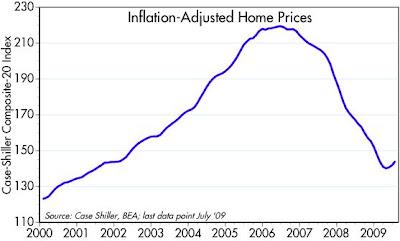
Supporting a continue rebound could be the low 15-year and 30-year mortgage rates that we’re seeing, which are both at or near all-time lows. I read the other day that 15-year mortgage rates were at an ALL-TIME low and that the average 15-year fixed rate was below 4.5%! That’s so attractive it has me thinking about refinancing again. Be sure to take a close look at the graph above (courtesy of Standard & Poors Case-Shiller) as there are several noteworthy items. First of all, you can see home prices peaked in 2005. I’ve heard many in the industry still stating that we’ve dropped back to 2005 home prices but the fact is, 2005 was the last year we saw INCREASES. We’ve actually dropped back to 2002 home prices nationally. Do keep in mind this is a national average based on what the S&P Case-Shiller determines to be the 20 most noteworthy markets in the country to track (Kansas City isn’t one of those 20 cities). It also just so happens that Kansas City didn’t see the huge increases in the boom, so our bust is smaller (no pun intended) here in Kansas City, than in California for example (OK, pun intended). Of course, also note the right side of the graph showing the past three months of increasing home pricing. Here’s to a fourth one.

Posted by Jason A. Brown
COMMENTS CAN BE LEFT BELOW…
(Click post headline if you don’t see the LEAVE A COMMENT section.)

Without Title Insurance, Kansas City Home Buyers Would Be Playing Real Estate Roulette

Hands On The Heartland
Checking The Pulse Of The Kansas City Real Estate Market

If you’ve purchased a Kansas City home, you were probably aware that the home transaction included title insurance. But many Kansas City home sellers and buyers vaguely understand it’s importance, how much it costs and who pays for it. Title insurance is a one-time fee paid at the real estate closing and the coverage lasts as long as the purchaser owns the home. Live there 20 years and the title policy is still guaranteed — assuming you don’t refinance the home in the mean time. There would be a new policy issued by a new (or possibly the same) title company if refinancing. In Kansas City, home seller’s pay for title insurance on an adjustable scale based on the sales price of the home. Buyers who are taking out a loan on the home usually pay an additional fee to have the lender covered on the title policy – that fee is usually right around $200. To give you an example on the seller’s side of the transaction, one Kansas City title company is currently charging sellers around  $300 for a $100,000 home and $400 for a $200,000 home.

Why does a Kansas City home seller need to provide title insurance? Because any sane buyer isn’t going to purchase a property that could have a current claim against it – or the dreaded hidden defects or future claims that can rear their head. Think about what could happen if long lost cousin Billy suddenly shows up with a valid interest in a property you inherited and that’s since been sold. The potential possibilities for claims, lawsuits, liens, judgments and other defects are limitless really. It’s such an important matter that long ago my Kansas City Regional Association of Realtors included a title insurance clause in the base real estate sale contract.

There are several large title companies in the Kansas City area and many smaller ones too. The prices charged do vary but generally are close and within $100 for any given price range. So what happens if the title company messes up and there IS some future claim the title company should have known about or has overlooked? Most title policies guarantee the title company will defend you free of charge and ultimately cover you against any losses resulting from settlements involving the claim. There are caps on the amount of losses a title insurance will pay and you can ask your title company that question if you have any concerns. Title insurance losses occur infrequently but when they do they can have devastating consequences for owners without title insurance.

Posted by Jason A. Brown
COMMENTS CAN BE LEFT BELOW…
(Click post headline if you don’t see the LEAVE A COMMENT section.)
Get That 3.5% Down Payment Together Before You Head Out To View Homes

Hands On The Heartland
Checking The Pulse Of The Kansas City Real Estate Market


Unless you’re paying cash for a home or have VA loan eligibility, there’s no point in heading out to view homes if you aren’t able to make a 3.5% down payment. On a $200,000 home that means you need to have $7,000 saved up. That’s what FHA requires and it’s 1.5% less down payment than you’d have to have if doing a conventional loan. I was surprised to read this week that FHA is currently backing 25% of all mortgage loans in today’s market! That’s about double what they were doing less than a year ago. My first reaction was that FHA is playing an important role in trying to pull our real estate market out of the funk it’s in. My second thought was they sure are taking on a lot of risk at time when few are willing to step up. My fears were eased when I saw that the average  FHA buyer’s credit score had jumped from 630 to 690 – that’s a huge jump. FHA is still taking on some risky buyers with credit scores below 500 but the risk involved with a potential default is lessened by their requirement that these buyers have a 10% down payment.

This leads to me to a question I often here from Kansas City home buyers… “Should I get an FHA or conventional loan?”.  If you’re a buyer who is scraping together a down payment, there’s a huge advantage in the 3.5% minimum FHA down payment versus the 5% minimum conventional loan down payment. And that’s the main reason many buyers go FHA. Yet Conventional loans are still the most popular loans made today and that’s because their less complicated all the way around.  Yet there are many distinct advantages to going FHA as well and here ‘s some random FHA loan versus Conventional loan thoughts to consider…

  • The maximum FHA loan amount for the Kansas City area is currently $271,050.
  • Conventional loans USUALLY don’t have a pre-payment penalty; FHA loans NEVER have a pre-payment penalty.
  • FHA loans require about TWICE as much effort on the borrower to provide the lender with necessary supporting documents on employment, income, etc.
  • Although proving qualifications is harder, the actual qualifications for an FHA loan are less restrictive than on a conventional loan.
  • FHA allows up to 6% in Seller concession (i.e. seller payed buyer closing costs); Conventional loans only allow up to 3% in Seller concessions.
  • FHA loans require a 3.5% minimum down payment; Conventional requires a 5% minimum down payment.
  • Unlike conventional loans, the down payment on an FHA loan can be gifted by a relative.
  • To get roughly an equivalent interest rate on a conventional loan, you’d need a 10% down payment (although only 5% is required); Conventional rates are often better than FHA rates if buyer has more than a 10% down payment.
  • Conventional loans with less than 20% down payment go through TWO underwriting procedures (one for the loan and one for the PMI); FHA loans go through just one underwriting procedure.
  • Conventional loans have no up-front PMI; FHA loans have a significant up-front PMI fee of 1.75% of the loan amount (the fee can be financed into the monthly payments).
  • FHA loans have a streamlined refinance process and the loans may also be assumable by another buyer later.
  • Contrary to many rumors FHA loans are not just for First Time Home Buyers.
  • There are no income minimums or maximums to qualify — yes, Donald Trump can go FHA.
  • FHA won’t make loans on homes that were involved in a sale within the past 90 days.
  • FHA won’t make loans on homes with major structural or condition issues.
  • Seller’s don’t like FHA loans because the appraisals are more strict and take longer to fund at closing.
  • Appraisers are held to strict FHA guidelines for declining markets (which has been just about every market).
Posted by Jason A. Brown
COMMENTS CAN BE LEFT BELOW…
(Click post headline if you don’t see the LEAVE A COMMENT section.)

Kansas City Home Builders Make YouTube Plea To Congress For Housing Stimulus

Hands On The Heartland
Checking The Pulse Of The Kansas City Real Estate Market


Kansas City home builders, tired of being ignored by Congress, last week jumped on the YouTube social media platform to get their message out. The home builders plea was for Congress to throw a lifeline to the housing industry that so many developers, general contractors, sub-contractors, real estate agents, decorators, local city budget’s, and others farther down the line, count on. It’s been clear to me for a long time that until Congress does something to fix the housing problem, there isn’t going to be a sustained economic recovery in this country. I come from a home building family and this issue touches me moreso than the typical Kansas City real estate agent. I’ve watched too many reputable home builders and developers go under due to no sales in recent months. One developer I talked to went 7 months without a sale and he said he can only last another couple of months before he’s out of business.  You’ll see many similar messages on this video…

If you read my blog often you know I’m a numbers guy and I look to statistics to see how our local real estate communities are doing. It’s discouraging to see that the “best selling” new home communities are only selling a couple of homes per month. I think about all of the people who’s lives revolve around the building industry and who are falling further into turmoil. Looking at the statistics, in July 2005 there were 837 new homes Sold (closed) in the Kansas City metro. In July 2007 there were 561 new homes sold. In July of this year (2009) the number had fallen all the way 269 new homes sold (closed) in the Kansas City metro area. The numbers are even worse than they appear because many of this July’s new home sales were homes that were started 1-2 years ago and being sold at a loss by the builder – or bank that now owns the home. In the video, it states that new home starts have fallen from around 12,000 to the 2,000 range in just three years!

If Kansas City home builders are running at about 1/6th of the volume they were just a few years ago, that makes for a lot of home builder superintendents losing their jobs, a lot of  lighting and appliance companies not supplying fixtures, a lot of framers with worthless nail guns, a  lot of  manufacturers with nothing to produce… God bless my friends in Kansas City who own car dealerships – and I hope the  Cash For Clunkers stimulus they’ve received has made a difference – but housing is an even more important catalyst to our economy than the automobile industry.  It’s time for Congress to act.

Posted by Jason A. Brown
COMMENTS CAN BE LEFT BELOW…
(Click post headline if you don’t see the LEAVE A COMMENT section.)

Time Running Out For Kansas City Home Buyers To Jump On The $8,000 Tax Credit

Hands On The Heartland
Checking The Pulse Of The Kansas City Real Estate Market

The expiration date for the $8,000 tax credit is December 1, 2009. I’m finding out that many first time Kansas City home buyers don’t realize that they must close on the home by December 1st.  Diligent lenders and new government regulations on how loans are done is adding time on to loan process – and thus on how long it takes to get a home closed. While it’s still possible to get some loans completed and ready for closing in 3 weeks, you’re asking for trouble if you count on it. In fact, most lenders are telling me to advise buyers to seek no quicker than a 30 days closing and 45 days is a much better plan.

Time Is Running Out On $8000 Tax Credit

Time Is Running Out On $8000 Tax Credit

45 days before December 1st would put us around October 15th or sooner for getting under contract and having a realistic opportunity to enjoy the $8,000 tax credit. Can you imagine being a home buyer where the appraisal is delayed causing the loan to not be ready by December 1st? What is the recourse for the homebuyer? The answer is none under the current rules. Of course the government is changing the rules on a daily basis and what I’m writing right now could be outdated tomorrow.

As of right now, having a signed contract is not good enough. Having a full loan approval is not good enough. Having a ready, willing and able buyer, seller, lender, appraiser, title company, home inspector, repair company, home warranty company, listing agent and buyer’s agent, is important but if the home closes on December 2nd you can forget about receiving that $8,000 to replenish the checking account, to pay of those credit card bills, to go to the Bahamas or  to invest in the stock market (yes, some of us are still doing that).

A good time line is to start looking at homes 60 days before you’re ready to close. So if we started a home search on October 1st that would be enough time to locate a home, go under contract and be closed by December 1st. But if you’re not a gambler and want to allow yourself some time should a close date extension be needed for some reason during the process, then you’re advised to plan for a closing date of, say, November 1st. That would mean starting the home search by September 1st. That’s about a month from now, so if first time homebuyers want to take advantage of the $8,000 government handout, they should get pre-approved, select their real estate agent and start narrowing their search parameters online over the next few weeks.

Posted by Jason A. Brown

COMMENTS CAN BE LEFT BELOW…
(Click post headline if you don’t see the LEAVE A COMMENT section.)

Asking The Magic 8 Ball “Is Now A Good Time To Buy A House In Kansas City?”

Hands On The Heartland
Checking The Pulse Of The Kansas City Real Estate Market

I asked the Magic 8 Ball “Is now a good time to buy a house in Kansas City? and the answer was “Maybe”. Worthless Magic 8 Ball. OK, I do believe it’s a good time to buy a home because there are so MANY great deals in today’s marketplace. I must go further though and add that it weren’t for the historically low interest rates and the government handing out huge home buyer tax credits, it would be a more difficult argument. Strictly from an investment stand-point, many would argue it’s a risky time to be buying real estate.  But it’s also possible that we’re nearing the bottom of the market and those jumping in today could make others look silly for not  having jumped into 2009’s real estate market that is plush with tax credits and low interest rates.

Should You Buy A Kansas City Home?

Should You Buy A Kansas City Home?

Let’s look at a hypothetical example of buying a $200,000 home today or waiting three years to buy a $200,000 home. If a buyer purchased a home for $200,000 today and it lost $8,000 in value the next three years, the $8,000 tax credit they received when purchasing would negate the loss in value – so you can see the huge cushion the  government is providing with these tax credits – and if the home didn’t lose any value then the buyer really makes out like a bandit.

Let’s now take a look at interest rates. If a $200,00 home was purchased today at 5% interest rate (with 3.5% down) the principal and interest (P&I) payments would be $1,035/month.  Now if the buyer waited three years to purchase that $200,000 home and interest rates jump to 7% (which is entirely possible), then their P&I monthly payments would be $1,284/month – meaning the borrower is losing about $250/month by having waited. That would equate to a $3,000 loss each year going forward and $9,000 over the next three years!

Let’s also factor in the mortgage interest deduction. We have to make an assumption here, so let’s assume the buyer of a $200,000 home is in the 25% tax bracket (keeping in mind that I’m no accountant). A borrower who pays $1,000 interest per month would be able to write off 25% of each month’s interest and in this scenario that would be $3,000 each year – so that would be $9,000 over the three year period!  If renting, there would of course be NO interest write-off.

Putting all three factors together, the buyer who doesn’t purchase in 2009 would lose (1) the  $8,000 tax credit, (2) $9,000  in the 2% jump in interest rates and (3) $9,000 in mortgage interest deduction for having rented versus owning.  That would be $26,000 lost over just THREE years by waiting to purchase a home. These losses would of course continue to mount each and every year thereafter as well.

The pride of home ownership should also not be underestimated.  The great wealth made during the housing boom led many to forget the main reason our parents and grandparents owned a home – shelter. It’s entirely possible that a person who loses a few thousand on a home rather than renting is a happier, more productive person for having owned and lost some value than for having rented and treaded water. All I’m saying is that there are intangibles that can not be quantified when it comes to home ownership. I guarantee that if you told me my options were losing a few thousand over a few years owning versus living in an apartment, the decision would be easy. I lose  thousands on my vehicle each year and you could bet I’d also choose to own and lose a little over living in an apartment. Of course,  there are other choices besides just those two scenarios – one of those being to locate one of the many great real estate deals that are out there today.

Posted by Jason A. Brown

COMMENTS CAN BE LEFT BELOW…
(Click post headline if you don’t see the LEAVE A COMMENT section.)