How Would Elimination Of 30 Year Fixed Rate Loans Affect Kansas City Home Buyers?

Checking The Pulse Of The Kansas City Real Estate Market

The other day a Realtor told me she didn’t care if Fannie Mae never backed another loan. Her argument was that Fannie Mae is backed by the government and government shouldn’t be meddling in the mortgage business. She added that the failed loans that Fannie Mae provided are a large reason for the downturn in the real estate market. There is some truth to that but the problems we’re faced with run deeper. But even if you agree 100% with this agent’s assessment, consider this… Fannie Mae is the major reason the majority of home loans were made during recent decades. Without Fannie Mae many Americans would not have a home and those who still would wouldn’t have mortgage loans as we know them today.

Without Fannie Mae, there would likely be no more 30 year fixes rate loans made. Why is this you ask? Because many private lenders aren’t willing to guarantee an interest rate for 30 months, much less 30 YEARS. And that’s exactly what Fannie Mae promotes. You go to your local bank to get a loan, your local bank runs a combination of you and your home through the Fannie Mae underwriting system and, if things look good, Fannie Mae will guarantee a 30 year fixed rate loan… and you get your loan. If interest rates jump from 5% to 10% over the coming years, there’s no worries because your interest rate is locked and guaranteed.

But if Fannie Mae wasn’t standing there to back the loan, do you think your local bank would lock and guarantee an interest rate for 30 years? Most banks wouldn’t do it when times were great, so most surely won’t do it today. What does all this mean to us as home buyers? If Fannie Mae goes out of business, the available loan types that our local lenders will make will be MUCH more conservative. Start thinking about 3 years ARMS which put the interest rate risk on you as the buyer and takes long-term interest rate risk off the banks making the loans. Yes, I’m talking about those same 3 year ARMS that caused tons of foreclosures when the interest rates starting re-setting in year 4.


Posted by Jason A. Brown

Add to DeliciousAdd to DiggAdd to FaceBookAdd to Google BookmarkAdd to RedditAdd to StumbleUponAdd to TechnoratiAdd to Twitter

Kansas City Home Buyers Getting FHA Loans To Face Higher Monthly Mortgage Payments

Checking The Pulse Of The Kansas City Real Estate Market

So in addition to the possibility of Fannie Mae being put out of her misery (and ending conventional loans as we know it), now it’s announced that FHA loans will have 1/4 percent higher annual mortgage insurance premiums. This is guaranteed to lower the volume of FHA loans once the increase is put into effect in April. The FHA change directly affects borrowers getting an FHA loan while making less than a 5% down payment. Of course, that’s the majority of borrowers who often choose a FHA loan because it only requires a 3.5% down payment.  If you’re already approved for a FHA loan but have yet to go under contract, I suggest you get up and shake a leg.


The 1/4 percent increase comes from a jump from a 0.90% mortgage insurance premium (MIP) on these loans to 1.15% MIP. The jump is based on the loan amount. These changes are designed to keep FHA loans alive during a time when the agency is battling foreclosures on the books. The change is expected to generate more than $2 billion in funds for FHA and help the agency meet the congressional mandate to have 2% cash in reserves. While the news is certainly not good, allowing the FHA loan program to fail would have terrible consequences on our real estate market. Keep in mind that more than half of the loans being provided to home buyers today are FHA loans.

I ran some rough calculations and this change would increase the payment on a $150,000 loan about $30 or so per month.  That may not seem like a lot but it’s $360 year, so it will have an affect. If the loan amount were $300,000 the figure would double. Despite the changes, FHA is still a cost-effective loan for borrowers and will continue to be a leading loan options for first time buyers, buyers with lower incomes and buyer’s who have less than the 5% down payment required on conventional loans. Another note I found interesting was that FHA will not provide a refinance loan if the refinance does not reduce the borrowers monthly mortgage obligations by at least 5%. That seems like a solid, common-sense rule to me.


Posted by Jason A. Brown

Add to DeliciousAdd to DiggAdd to FaceBookAdd to Google BookmarkAdd to RedditAdd to StumbleUponAdd to TechnoratiAdd to Twitter

Receive Kansas City Home Community Updates Emailed To You From The Kansas City MLS

Checking The Pulse Of The Kansas City Real Estate Market

If you’re thinking of buying or selling an area home and have narrowed things down to a particular community, you should get set up to receive automatic market updates on the community. This will allow you to receive an automated email whenever a new listing comes on the market, when a home goes under contract and even when a come closes — thus allowing you to see the sales price of the homes! Everyone likes to know what homes are selling for in the neighborhood they’re considering buying or selling in, so let me help you stay current on the local market.

The only requirement I have for setting you up to receive these Kansas City MLS updates is that you confirm you’re not already tied into an agency agreement or other agreement with another Kansas City real estate agent. I won’t ask for any commitment at this time to using me as your buyer’s agent or listing agent.  If you think I might be a great option to help you buy or sell a home, please email me your name, email address, the home community you want to receive updates on and also let me know whether you’re considering buying or selling in the neighborhood.

Posted by Jason A. Brown
Add to DeliciousAdd to DiggAdd to FaceBookAdd to Google BookmarkAdd to RedditAdd to StumbleUponAdd to TechnoratiAdd to Twitter

If You’re Upside Down On Your Kansas City Home, Consider A Short Sale Before Walking Away

Checking The Pulse Of The Kansas City Real Estate Market

If you’re upside down on your home, you may wake up some mornings thinking about walking away from your home. Millions of homeowners in the U.S. are faced with this dilemma. But I’ve never met anyone happy to simply walk away from their home, uproot their family and damage their credit. But for many, the mortgage owed on their home is too large of an obstacle to overcome… and these two options seem to be the only options to many. But there’s a third option that more and more homeowners are using to deal with housing problem — that option is a Short Sale.


With a third option in the mix, it’s a lot to consider but just know that many homeowners who are successful in selling their home in a Short Sale are able to finance another home as quickly as two years down the road.  That possibility alone is exciting to many who were sure they weren’t going to able to get financing on another home for years to come.  Many homeowners will also ignore the Short Sale possibility because they don’t have the money to pay the closing costs. When I explain to sellers that their lender will pay all of the closing costs, including the real estate commission, most are very surprised. If they’re going to accept a Short Sale, your lender UNDERSTANDS you don’t have the money to pay these costs. So they factor them in when considering the Short Sale.

If you’re going to achieve a successful Short Sale, you’ve got to get your home under contract with a buyer. From there, you’ve got to submit the contract to your lender for review. Why would a lender agree to accept a Short Sale? Because if you aren’t able to continue making your payments, they realize that foreclosure is the other option. And lenders don’t want more REO properties on their books. When deciding to accept a Short Sale, the lender will have the home appraised – hopefully factoring in issues with the home – and decide whether it makes sense to accept the Short Sale (or decline it and foreclosure on the property and sell it later once they’re in control of the property).

The first step to getting the process moving is hiring a listing agent. Selling a home in a Short Sale is much different from a typical resale transaction and you’ll absolutely need an agent who knows what they’re doing. The initial list price of the home will need to be at market value, though the home is unlikely to generate interest at the initial list price. You need to start at market value however to show your lender you’re doing all you possibly can to sell the home for as much as possible. After a short amount of time on the market, you’ll want to start dropping the price incrementally until you locate a buyer — remember Short Sale buyers are not going to pay market value for a home that has to go through the unpredictable Short Sale process.

To make the Short Sale process as smooth as possible for sellers, I have a Short Sale specialist in my group to negotiate with your lender (with your approval). So while I’m busy working to sell the home and get it through the typical sale process, my negotiator is working with your lender to get their approval on the Short Sale. But don’t worry because I take care of the costs of having the negotiator working to move the process along. Buyer’s agents are becoming more aware of how the process works and asking questions up front. If a buyer’s agent senses the listing agent has no clue what they’re doing, they’ll likely advise their buyer clients to look elsewhere. So be sure you don’t just hire any agent and should you have any questions about the Short Sale process, please contact me to discuss your options.

Posted by Jason A. Brown
Add to DeliciousAdd to DiggAdd to FaceBookAdd to Google BookmarkAdd to RedditAdd to StumbleUponAdd to TechnoratiAdd to Twitter

Are You Underestimating Today’s Low Interest Rates When Deciding If The Time Is Right To Buy A Kansas City Home?

Checking The Pulse Of The Kansas City Real Estate Market

Mortgage interest rates have risen about a half percent recently but they’re still at unbelievable lows. Buyers who continue to sit the fence are likely costing themselves a higher mortgage payment down the road. Of course, the price of a home also needs factored into the equation, but interest rates have a more dramatic effect than many Kansas City home buyers realize.

If you’re thinking of waiting for lower home prices before you buy a home, consider the following scenarios…

Scenario 1 (Today’s market):
123 Oak can be purchased today for $200,000.
Interest rates are 5%.
Buyer’s monthly principal & interest payment would be $1,074.

Scenario 2 (Down the road):
Home prices fall 5 percent and now 123 Oak can be purchased for $190,000.
But interest rates rise 1/2 percent and are now at 5.5%.
Buyer’s monthly principal & interest payment would be $1,079.

Scenario 3 (Down the road):
Home prices fall 10 percent and now 123 Oak can be purchased for $180,000.
But interest rates rise 1 percent and are now at 6%.
Buyer’s monthly principal and interest payment would be $1,079.

So if interest rates rise ONE percent (which is eventually going to happen), then a buyer will be able to afford $20,000 less home ($180,000 versus $200,000) using the price range in the sample above! A general rule of thumb to use when considering whether to buy today or wait until tomorrow is this… For every half percent interest rates rise, you’ll be able to purchase 5% less home in the future.


Posted by Jason A. Brown

Add to DeliciousAdd to DiggAdd to FaceBookAdd to Google BookmarkAdd to RedditAdd to StumbleUponAdd to TechnoratiAdd to Twitter

New FHA Requirements Increase Minimum Down Payments For Many Kansas City Home Buyers

Checking The Pulse Of The Kansas City Real Estate Market

For the past several years it’s become more difficult for home buyers to secure financing. There’s been an obvious over-correction in the market as lenders went from giving your dog a loan for his dog house to not giving a self-employed borrower with 50% down and an 800 credit score a loan. But things have opened up enough now that solid buyers can secure loans and purchase a great home. But just when we need some more good news, FHA comes out this month with requirements making it more difficult for borrowers to secure an FHA loan.

If you’re credit score is anywhere below 500 you can not get an FHA loan any longer. Period. Though when I asked a few lenders just how many borrowers this would affect, they all said very few… because they weren’t giving loans to sub 500 credit score buyers in the past, even though FHA would have allowed it. The real change is for the borrowers with credit scores in the 500 to 579 range. Those borrowers must now have a TEN PERCENT down payment — rather than the 3.5% minimum down payment that previous borrowers with the same credit score needed.


Posted by Jason A. Brown

Add to DeliciousAdd to DiggAdd to FaceBookAdd to Google BookmarkAdd to RedditAdd to StumbleUponAdd to TechnoratiAdd to Twitter

Organization Is Key To Completing A Lenexa Kansas Home Purchase

Checking The Pulse Of The Kansas City Real Estate Market

Buying a home can be made easy in most cases by simply working with a great agent. By great agent I mean a real estate agent who knows what they’re doing and cares enough to make your transaction as important as if it were his or her own personal transaction. Everything I do in business is based on organization. One step into my office and you’ll understand just how important it is to me. When I walk out of my office each day, I feel great that the critical items have been handled and the rest is in order to start the next day. It takes just one lost piece of paperwork or dropping the ball on one item during the home buying process and the wheels can fall off the bus.

Let’s say your buying a home in Lenexa Kansas. After you’ve chosen the Lenexa Realtor that will represent you, the next step is choosing a great lender who works the Lenexa KS area. Once you have your loan Pre-Approval Letter in hand, it’s off to view homes. But wait… there more to an organized home search than just heading out to view any homes in the price range. Buyers should first scout the neighborhoods within their price range and desired area. At a minimum, checking out the main streets of the surrounding area will help you understand important factors around the neighborhood. Look for traffic flow, excessive noise, parks, shopping, dining amenities, etc. Always look closely at whether the neighborhood commons areas are well taken care of – it’s a tell-tale sign if they’re not.

When choosing homes to view, the process can vary greatly from one buyer to the next. Many  buyers prefer to receive  all the listings via email and then tell me which ones they want to see. A few want to give me their basic parameters and have me choose all the homes we see. In most cases, the best solution is a combination of the two. I set my clients up to receive email updates of listings that fit their parameters. I ask enough questions up front that only relevent listings are sent to buyers. Taking the time to check a few additional MLS boxes can go a long way towards making it easier for buyers to cull through the available MLS listings. Once the right home is found,  you’ll be counting on your agent for expert representation through the remainder of the real estate process and organization is just as critical during the rest of the real estate process.


Posted by Jason A. Brown

Add to DeliciousAdd to DiggAdd to FaceBookAdd to Google BookmarkAdd to RedditAdd to StumbleUponAdd to TechnoratiAdd to Twitter

Home Sales Are Slowing Despite Interest Rates Dropping Even Lower In Kansas City

Checking The Pulse Of The Kansas City Real Estate Market

Mortgage interest rates dropped yet again this week, giving buyers further opportunities to refinance their current home or buy a home and lock in low mortgage payments for the next 15 or 30 years. It’s hard to fathom that Kansas City home buyers can secure a long-term home loan at just 4.25% interest. This assumes the borrower has decent credit and a 5% down payment.  Yet it’s become apparent that low mortgage interest rates alone aren’t going to carry us into a housing recovery.


Today’s low interest rates simply aren’t stimulating buyers the way they have in the past. That’s understandable though with more than 10,000,000 U.S. homeowners upside down on their homes and many more worried about job security and whether home prices will fall further. The market has certainly changed from five years ago when Kansas City home sellers were selling a home they bought two years earlier and turning a profit — AFTER factoring in real estate commissions, title fees, moving costs, etc.

In the past, when mortgage interest rates dropped, it was the signal for home sales to pick up. This time around however, it’s just not bringing as many home buyers out of the woodwork. Although low rates haven’t picked the real estate market up, I wonder if they’ve prevented the market from a complete collapse. It’s impossible to say for sure and I’m just thankful that the home buyers who are searching for a good deal don’t have to factor higher interest rates into the buying equation.

Posted by Jason A. Brown

Kansas City Area Second Quarter Market Update Shows Promise For Kansas City Area Home Sellers

Checking The Pulse Of The Kansas City Real Estate Market

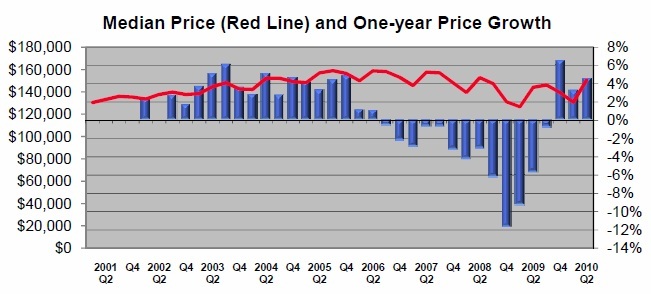
My National Association of Realtors has released the second quarter 2010 market statistics for the Kansas City metro area. The local trend shows that home prices have rising 4% when compared to the second quarter of 2009. The report gives us a look back nine years and I found it interesting to note that second quarter sales prices in the Kansas City area are down $7,100 on average compared to three years ago, but still up $5,900 over the past seven years.


So the average buyer who bought in 2003 is still ahead after the market downturn, but the average buyer who bought in 2007 is, well, wishing they’d bought in 2003. There’s a ton of other interesting information in the NAR report, including local employment growth at a rate better than most other markets and construction being on the rise – albeit it modestly – which indicates local new home inventories have stabilized.

The report also shows the Kansas City real estate market is one of the most affordable housing markets in the U.S. and there’s also details showing a decrease in the volume of loan delinquencies, thus suggesting area foreclosure rates should decrease in the future. Be sure to click the graph above to check out the entire report on the Kansas City metro area. Be patient after clicking on the graph as it’s a large PDF file and could take a minute to open.

Posted by Jason A. Brown

Don’t Be Confused About How Seller Paid Closing Costs Work When Selling Your Leawood Kansas Home

Checking The Pulse Of The Kansas City Real Estate Market

I had a Leawood Kansas home buyer sheepishly tell me they were hoping the home seller would pay their closing costs. I told them it was no problem to ask a seller to do so, but that we should avoid going down that path if possible. Any time a seller pays a buyer’s closing costs, the price of the home is artificially inflated by the correlating amount — and this could potentially create problems when the appraisal comes in later.  Despite the risks, it made sense for this buyer because they didn’t have enough money saved to cover both the necessary down payment and the closing costs too.

The process of a seller paying a buyer’s closing costs at closing is not all that complicated. Generally, on homes over $300,000, I rarely see a buyer ask the seller to pay any of the buyer’s closing costs. On homes under $200,000 I often see buyers ask the seller to pay some portion of their closing costs. In most cases, a seller won’t reject this request and they’ll instead just view the amount asked for in seller paid closing costs as a buyer asking that much less for the home (than what they offered in way of the offer price). Consult with a Kansas City mortgage lender to find out what percentage of the purchase price a seller would be allowed to pay of the buyer’s closing costs and still have the buyer qualify for the loan program.

If a home is listed at $200,000 and a buyer offers $195,000 and asks for NO seller paid closing cost, they’ve made an offer very similar to a buyer who comes in and offers $198,000 and ask the seller to pay $3,000 of the buyer’s closing costs. Both would equate to a $195,000 sale price overall. The biggest difference is the seller may have to pay a real estate commission on the $3,000 higher sale price in scenario two. If they did, $3,000 times a 6% commission would leave the seller paying $180 higher real estate commission. Pretty minor in the big picture. But even that rarely happens because most listings are advertised to buyer’s agents as the commission being paid on the NET sale’s price – meaning the seller wouldn’t have to pay the commission on that $3,000 anyhow.

In our current market, the appraisal should be a consideration in whether seller paid closing costs for the buyer should be part of the deal. If an appraiser determines the seller paid closing costs have inflated the home price by that amount (they have, haven’t they?), then it’s not out of the question that the appraisal could come in lower than the sale’s price. If so, we have a problem Houston. For this reason, it’s always best to avoid seller paid closing costs if a buyer has the money to pay their closing costs. But in a situation where the buyer can come up with their 3.5% FHA down payment but doesn’t have enough for the closing costs, then it could make sense to have the seller pay some of the buyer’s closing costs.

As I’ve mentioned, it’s important that a buyer understand they aren’t really “saving” the amount the seller is paying in closing costs. They just don’t have to pay it up front. They are no doubt paying more for the home than would have if they hadn’t asked for the seller paid closing costs and they also will be paying interest on that amount since it has been financed into the home loan (by way of the higher sale price on the home). And when you sell the home later, what you net on the home sale will be that much less, because a buyer isn’t going to view your home as worth $3,000 more just because the seller agreed to pay your closing costs (and you were willing to pay a higher sale price to make it happen). But, in many cases, seller paid closing costs can make sense for both a buyer and seller and be what it takes to make a deal happen.

Posted by Jason A. Brown